
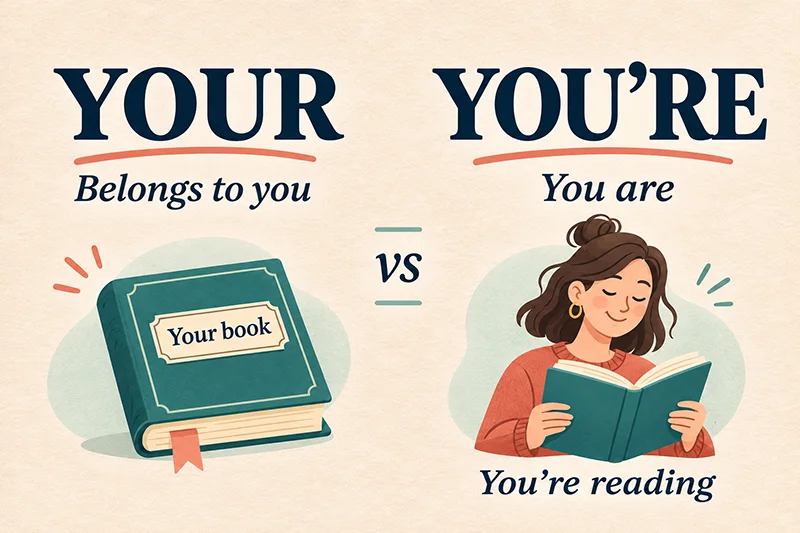
“Hope your having a good week.” One word needs a repair: it should be “Hope you’re having a good week.”
These words sound alike, so reading aloud may not help. Instead, try replacing the doubtful word with you are.
You’re means “you are”
You’re is a contraction of you are. The apostrophe marks the missing letters:
- You’re welcome to join us. → You are welcome to join us.
- I think you’re right. → I think you are right.
- Let me know when you’re ready. → Let me know when you are ready.
If you are fits your meaning, use you’re.
Your connects something with you
Use your when something belongs to, or is associated with, the person you’re addressing:
- Have you saved your work?
- Your appointment is at ten.
- Please give us your opinion.
It needn’t be something you own: appointments and opinions count too.
Try “Please check your address”. “Please check you are address” doesn’t make sense, so your is correct.
Both words can appear together: You’re responsible for checking your contact details. You are responsible; the details are yours.
Is it “your welcome” or “you’re welcome”?
When replying to thanks, write you’re welcome: you mean you are welcome.
But your welcome can be correct: Your welcome made us feel at home. Here, welcome is a noun meaning the greeting you gave. Check the whole sentence before deciding.
What about yours?
Compare:
- Is that your coat?
- Is that coat yours?
Your comes before the noun; yours stands alone. Neither possessive form needs an apostrophe: write yours, never your’s.
Have a go
Choose your or you’re:
- I think ___ cat has stolen my chair again.
- If ___ bringing biscuits, ___ always welcome.
- Please check ___ microphone before explaining why ___ still in pyjamas.
- ___ welcome was so enthusiastic that the dog joined in.
Answers
- your: the cat belongs to the person you’re addressing.
- you’re; you’re: you are bringing biscuits; you are always welcome.
- your; you’re: the microphone is associated with you; you are still in pyjamas.
- Your: welcome means the greeting you gave.
When proofreading, pause at each your and you’re and try you are. It’s a useful habit when checking everyday writing.